Deep Learning & How to Choose the Right Model
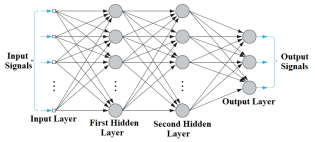
Multi-Layer Perceptrons (MLPs)
This is the original “neural network”.
Useful if you have “traditional” (bag of variables) datasets and need a nonlinear model, if you have enough data.
Beware of making MLPs too “deep” - they can become hard to train.
Convolutional Neural Network (CNN)
- Based (loosely) on concepts taken from models of how the human visual cortex operates.
- Rely on convolutional operations to provide some translation invariance.
- Learn visual features in a hierarchical fashion.
- Also proven useful in non-vision applications.
![]()
- Convolutional Neural Networks https://anhreynolds.com/blogs/cnn.html
- Understanding Convolutions: https://towardsdatascience.com/intuitively-understanding-convolutions-for-deep-learning-1f6f42faee1
- Convolution Arithmetic: https://github.com/vdumoulin/conv_arithmetic
- 10 CNN Architectures: https://towardsdatascience.com/illustrated-10-cnn-architectures-95d78ace614d
Image from https://anhreynolds.com/blogs/cnn.html
Convolution
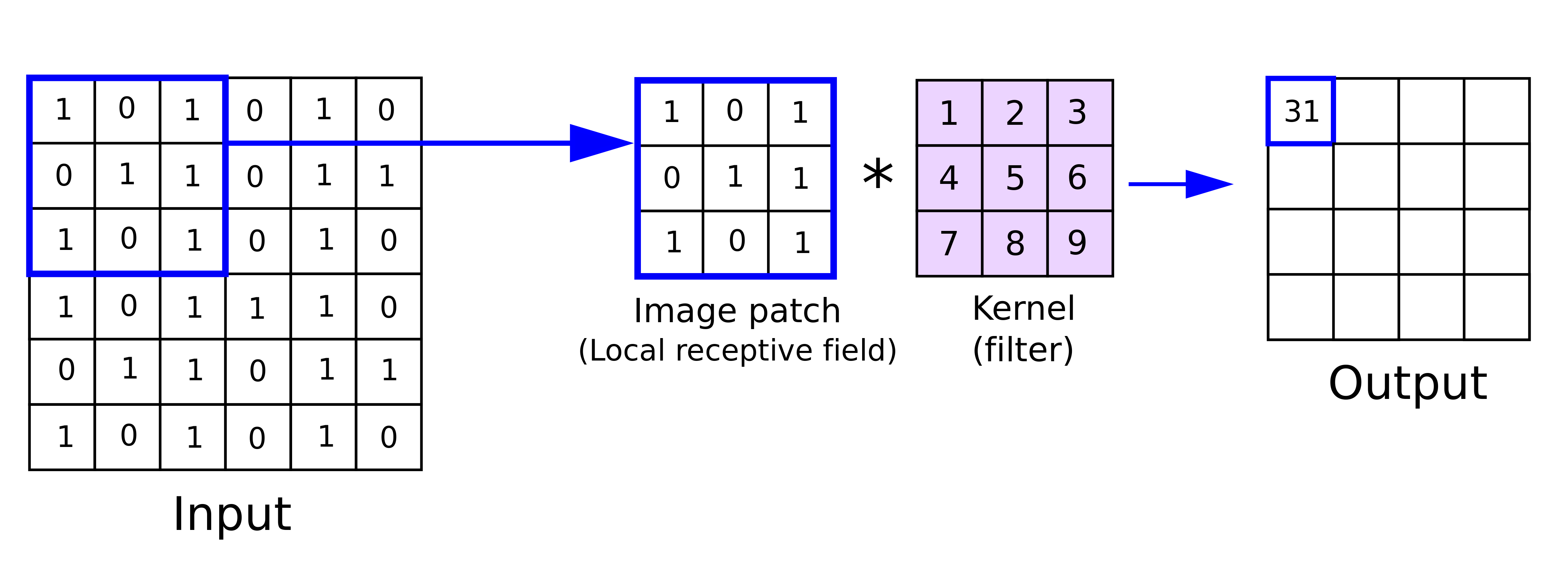
Each \(N\times N\) patch in the Input is “compared” (via dot product) to the filter (or kernel) and the result creates a single pseudo-pixel in the Output.
Image from https://anhreynolds.com/blogs/cnn.html
Convolution Filters : Edge detection
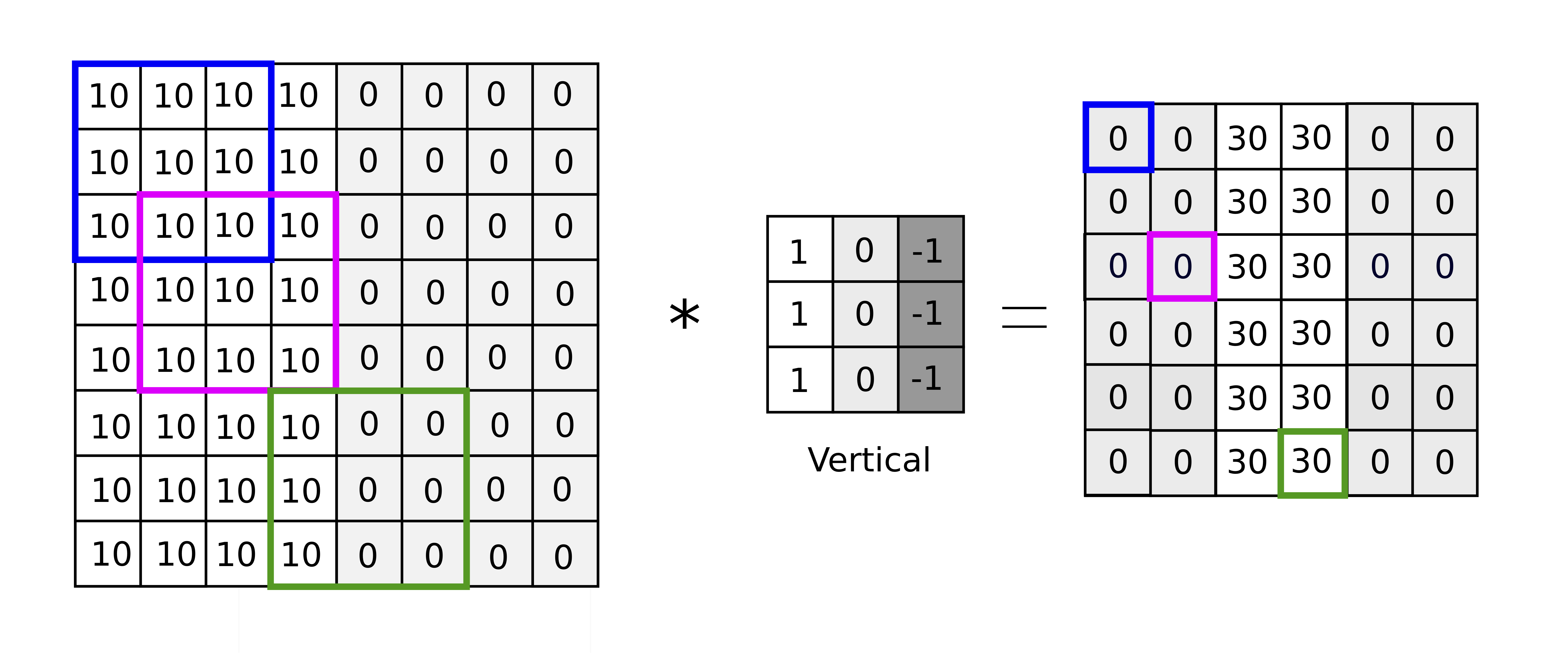
An example kernel that will provide vertical edge detection. Notice how it responds highly at the boundary between the “lighter” and “darker” pixels in the input.
In practice, we don’t hand-craft the filters—we let the network learn them. (In other words, the values in the filter are weights (or parameters) in the model.)
Image from https://anhreynolds.com/blogs/cnn.html
Sequential and Generative Models
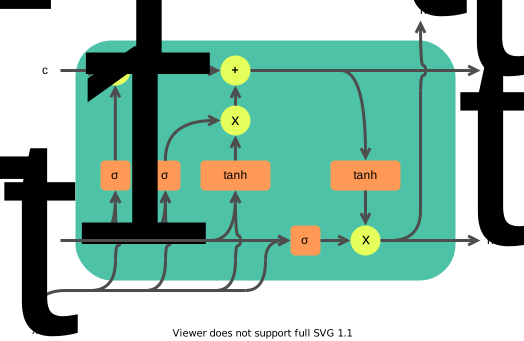
Recurrent Neural Networks (RNNs) & LSTMs
- Designed for sequential/timeseries data; output depends on previous inputs.
- LSTMs added gating to preserve long-range dependencies.
- Largely superseded by Transformers for most sequence and NLP tasks.
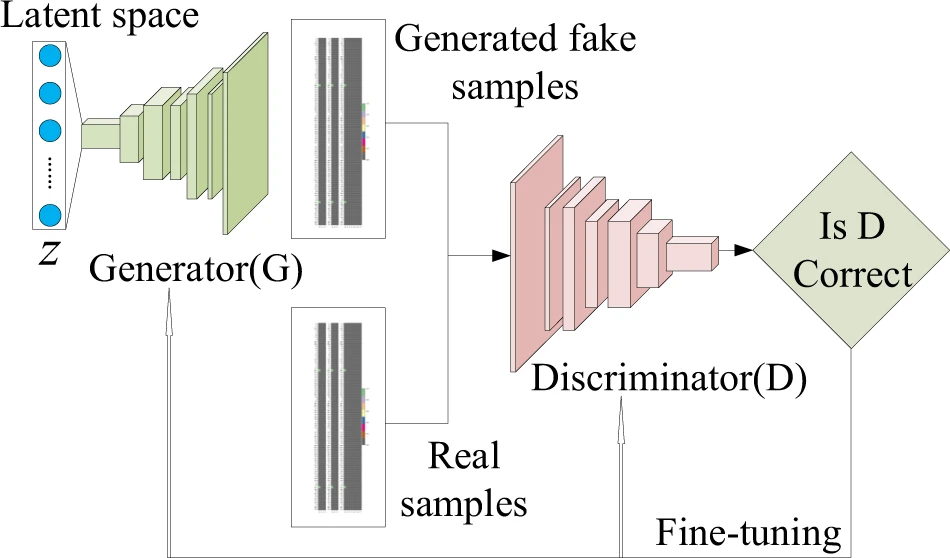
Generative Adversarial Networks (GANs)
- Train a discriminative and a generative model in competition.
- Produced impressive image generation results through ~2022.
- Largely superseded by Diffusion Models for generative tasks.
LSTM Cell image: https://upload.wikimedia.org/wikipedia/commons/5/56/LSTM_cell.svg
Autoencoder
- Autoencoder is one of the few unsupervised deep learning models.
- It learns to reproduce its input as precisely as possible by first encoding it to a latent feature-space representation, then decoding that representation back to the original dimensionality.
- Can be used for compression, denoising, and more.
- Can be used for pre-training weights for “few shot learning”.

- What is AE used for?: https://towardsdatascience.com/auto-encoder-what-is-it-and-what-is-it-used-for-part-1-3e5c6f017726
- Autoencoders (Stanford): http://ufldl.stanford.edu/tutorial/unsupervised/Autoencoders/
- Autoencoders: https://www.jeremyjordan.me/autoencoders/
- LSTM Autoencoders: https://machinelearningmastery.com/lstm-autoencoders/
Autoencoder Image: https://upload.wikimedia.org/wikipedia/commons/2/23/Autoencoder-BodySketch.svg
Transformer Networks
Transformer networks were introduced for natural language processing (NLP) but have since become the dominant architecture across many domains — text, vision, audio, and time-series.
The key feature of transformer networks is the self-attention mechanism, which allows the network to weigh different parts of the input differently based on relevance. This replaces the recurrent state used in RNNs.
Vision Transformers (ViT) apply the same architecture to images (split into patches), and now match or exceed CNNs on many vision benchmarks.
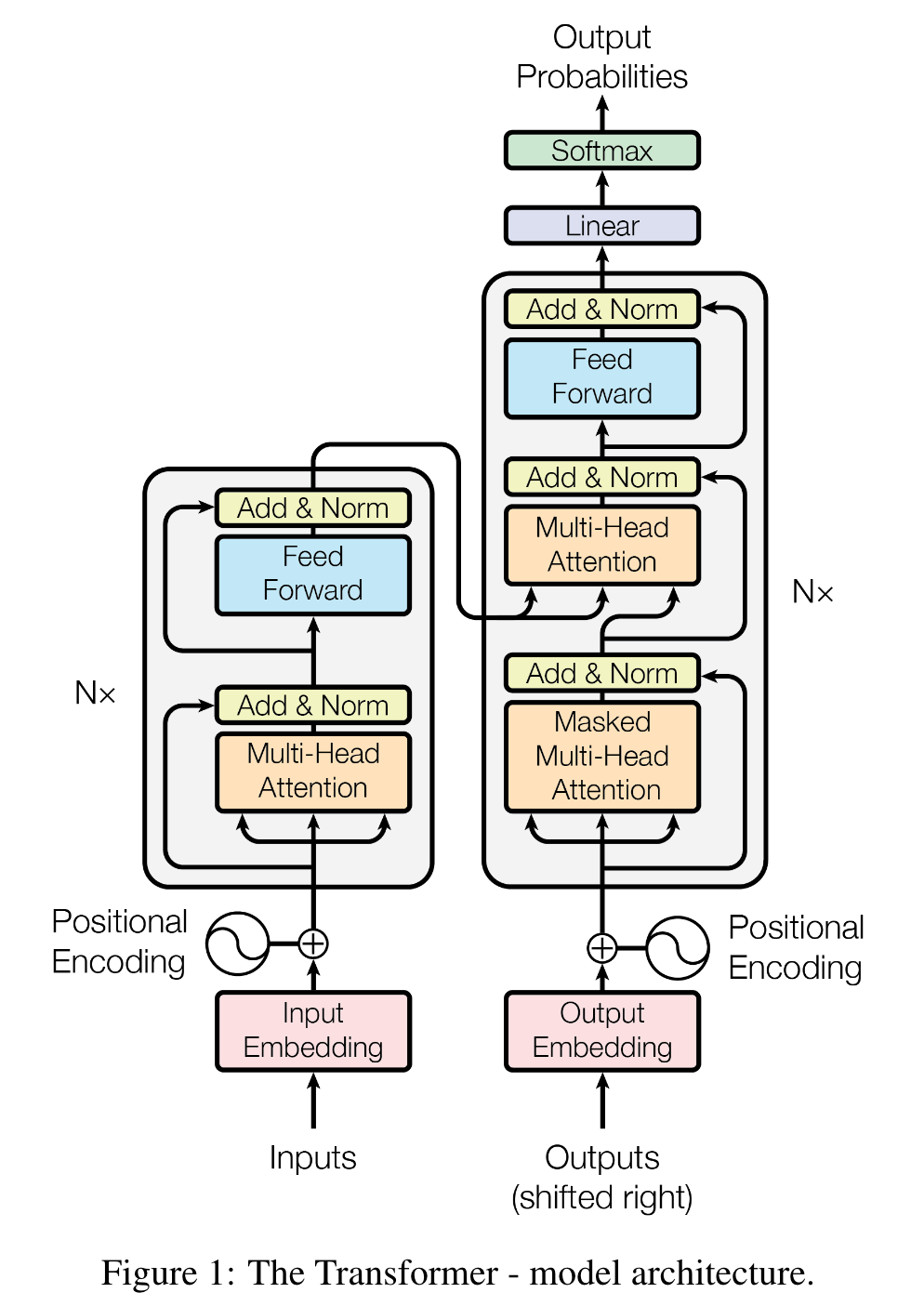
Images: A. Vaswani et al., “Attention Is All You Need,” arXiv:1706.03762 [cs], Dec. 2017 [Online]. Available: http://arxiv.org/abs/1706.03762.
Learn More
Deep Learning Book (by Ian Goodfellow, Yoshua Bengio, and Aaron Courville) - a comprehensive textbook covering a wide range of deep learning topics. https://www.deeplearningbook.org/
Papers with Code - a website that aggregates recent research papers and provides open-source implementations and evaluation metrics available with each of them. https://paperswithcode.com
MIT Deep Learning Series - a collection of video lectures by prominent researchers, designed to give a broad overview of the field of machine learning and deep learning. https://deeplearning.mit.edu/
Coursera Deep Learning Specialization - a series of online courses providing a graduate-level introduction to deep learning. https://www.coursera.org/specializations/deep-learning
PyTorch.org - the leading open-source platform for deep learning, with broad adoption across both research and industry. https://pytorch.org/
TensorFlow.org - a widely-used open-source platform for constructing and training machine learning models, including deep learning. https://www.tensorflow.org/

Deep Learning & How to Choose the Right Model